

How to Identify Scale Insects
Scale insects often look less like insects than like tiny bumps attached to a houseplant. Look along stems, leaf veins, petioles, and sheltered leaf bases for rounded or flattened spots that remain in place when the leaf moves. Some species produce sticky honeydew; others do not. The useful question is not simply “Are there brown spots?” but “Is there a distinct organism attached to the surface, and what other evidence supports that diagnosis?” A close inspection with good light and a hand lens can help you answer it before you reach for a spray.
The process below is designed for tropical foliage collections, including plants with thick, waxy leaves, delicate new growth, or complicated leaf bases. It works as an identification framework rather than a promise that every species can be recognized by sight. If your evidence is ambiguous, isolate the plant and collect clearer photographs instead of treating a guess as a confirmed infestation.
What scale insects actually look like
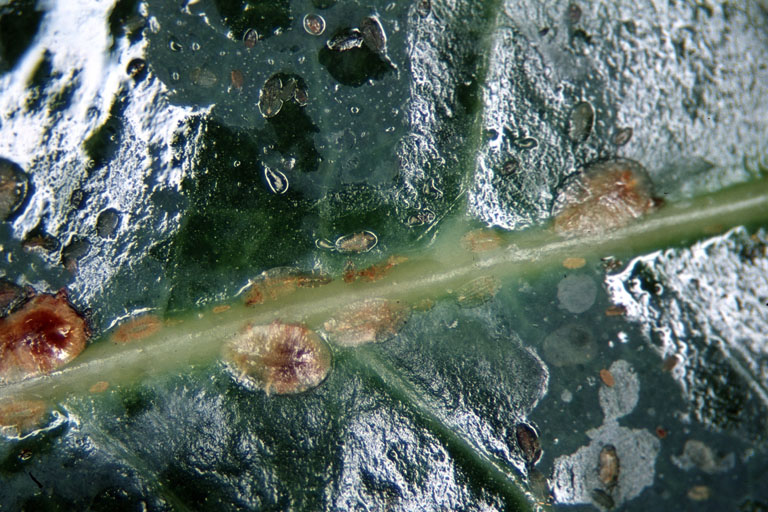
Scale insects are sap-feeding insects in a diverse group, not one single species with one characteristic color. Many females become relatively immobile after settling, and their protective wax or covering disguises the body beneath. Depending on the species and age, an infestation can resemble tan dots, brown half-domes, pale flattened discs, chalky patches, or a cluster of wax-coated beads. Several types can be present on plants that are otherwise growing normally, particularly early in an infestation.
Look for an object with a defined edge that appears to sit on the plant rather than a mark that is part of the tissue. Scale may occur singly, but repeated bumps of similar shape concentrated around veins or branching points strengthen the suspicion. Their placement can be more informative than color. A small brown dome directly beside a petiole joint is worth checking; a larger brown patch with an irregular margin and visibly damaged tissue calls for a different diagnostic path.
Use the same approach with a variegated leaf. Cream, yellow, or pale green markings are normal for many cultivars, while stippling, scarring, and localized browning can have several causes. Color change is not a diagnosis. Examine the supposed insects themselves and compare multiple leaves, not just the most damaged one. Photograph both the affected surface and an unaffected part of the same plant if possible.

How to inspect a plant, step by step
First, move the plant to a bright, stable work surface where you can see both the upper and lower leaf surfaces. Natural diffuse light or a bright task lamp is easier for close inspection than a dim room. Put a sheet of pale paper underneath if you intend to inspect debris. Keep the plant away from nearby collections while you work; this is especially useful for a newly arrived plant or one with several unexplained spots.
Start with the newest growth and the leaf bases, then follow each petiole toward the stem. Next inspect the main veins on both sides of mature leaves. Check places where leaves overlap, around nodes, underneath stem sheaths, and in any folds that shield insects from casual view. On very dense foliage, work systematically from one side of the pot to the other. Randomly lifting the same two leaves can create false reassurance while a colony remains hidden behind a third.
A phone camera with a close-focus or macro option can document what you see. Take one photograph showing where a suspected colony sits on the plant, then a closer photograph of two or three individual bumps. Avoid digitally sharpening the image so aggressively that the outlines become artificial. A hand lens of about 10× magnification can reveal body shape and small crawlers that are nearly impossible to distinguish at arm's length. You do not need a laboratory to begin the process, but magnification helps you avoid unnecessary treatment.
Make observations in this order: location, shape, surface attachment, accompanying residue, and change over time. Notice whether you see identical objects repeated in sheltered places; whether any can be distinguished from the leaf tissue; and whether a lower leaf or the surface underneath is unusually sticky. If ants are present, record them, but do not assume they prove scale insects: several sap-feeding pests produce honeydew that attracts ants.
Where the surface is robust, you can gently touch an individual suspect spot with the tip of a wooden toothpick or cotton swab. A true attached scale covering may behave differently from corked tissue, but vigorous scraping can injure the plant and may dislodge the evidence you need to identify. Avoid testing every bump on a valuable leaf. If you cannot tell what it is, take a photograph first, use a light touch, and stop if tissue begins to tear.

How to distinguish soft and armored scale
Distinguishing these two common groups changes how you interpret sticky residue. Soft scales often look rounded or dome-shaped and tend to be somewhat larger than armored scales. Brown soft scale is a familiar example on ornamental plants. Many soft scales excrete honeydew, a sugary liquid that can collect on leaves or nearby surfaces. Over time, sooty mold may grow on that residue. Neither stickiness nor sooty mold identifies the species by itself, because aphids, mealybugs, and whiteflies can also produce honeydew.
Armored scales typically have a comparatively flat, shield-like cover. In many species that cover is separate from the insect body and can sometimes be lifted with care. Armored scales generally do not produce honeydew. Therefore, a plant can carry a significant armored-scale infestation without the shiny, sticky signs that often alert growers to soft scales. Conversely, honeydew on a plant with brown bumps supports a soft-scale possibility but does not conclusively establish it.
A practical visual comparison is more useful than attempting a species-level diagnosis from color. Ask whether the suspected structures are high domes or flatter plates; whether many are arranged on the same stem or vein; whether the covering appears separate from the body; and whether there is associated honeydew. These are clues, not a universal field key. Juveniles, overlapping insects, wax deposits, and damaged old coverings can blur the distinction.
Do not remove many protective covers simply to settle the question. Lifting one carefully chosen cover may show different layers, but it can also crush an insect or damage a soft leaf. If treatment decisions depend on distinguishing a difficult species, a local university extension service or qualified plant diagnostic laboratory may be a better next step.

How to tell whether scale is active
A rigid brown shell may remain attached after the insect dies. That means a plant covered in old scale remains can look badly infested even when the active population has fallen. Equally, a plant with only a few visible adults may have new crawler stages elsewhere. Treat an individual shell as evidence of past or possible infestation, not an automatic measure of how many insects are alive today.
Examine several sites rather than testing one object. Fresh-looking bodies, tiny moving crawlers, new deposits on previously clean growth, or newly expanding clusters are stronger signs of activity than isolated old covers. Soft-scale honeydew may be another clue, although a sticky leaf can remain sticky after the responsible insect has been removed. Wipe a small reference area clean and note whether fresh residue returns while you monitor.
Crawlers are the young mobile stages of many scale insects. They are often tiny and may be easier to spot on a contrasting surface or with magnification. If you see moving specks, photograph them against the plant before assuming their identity. Other small insects and mites can move in the same locations. For plants with many stems, a dated series of comparable photographs gives a better picture of population change than trying to remember whether one leaf looked different last week.
Keep an inspection record that separates observations from interpretations. “Five pale bumps at the lower petiole joint; two new bumps after seven days” is useful. “Severe armored scale, definitely spreading” is less useful unless you have actually identified the insects and compared the same area at two times. Consistent notes help you decide whether to continue monitoring, remove visible insects, or seek further identification support.

How to rule out common lookalikes
Several houseplant problems can create dots or raised structures. Mealybugs are related sap-feeding pests, but many appear as soft, oval insects with conspicuous cottony or powdery wax. They commonly gather in axils and other protected places, just as scale insects do. When the white material appears fibrous and the underlying insects can be seen moving, mealybugs become an important alternative diagnosis. Some scale species also produce conspicuous wax, however, so “white equals mealybug” is not a reliable rule.
Edema, also spelled oedema, is a physiological problem in which cells are damaged after a mismatch between water uptake and water loss. Symptoms can include blister-like bumps or corky marks, depending on the plant and the stage of injury. Unlike an attached insect, a corked area tends to be integrated with the leaf tissue. It may be part of an irregular patch rather than a repeated series of distinct bodies. Examine both sides of the leaf and consider recent changes in watering, airflow, and environmental conditions. Edema and pests can coexist, so one diagnosis does not automatically exclude the other.
Lenticels, normal corking, leaf scars, and dried sap can also resemble small attached objects. A regular pattern along a stem, symmetry across similar stems, and a lack of new colonies elsewhere may suggest a plant structure rather than an infestation. Old mechanical damage tends to follow the injury site; residue from guttation or a sticky spill may wash away without revealing any insect beneath. These clues are context-dependent. Do not scrape living tissue to force a clear answer.
Sooty mold is another frequent source of confusion. It is usually a dark fungal growth associated with sugary deposits, not a species of scale insect. Its presence should prompt you to look for honeydew-producing insects, but it does not prove that scale is the culprit. Check for aphids, whiteflies, and mealybugs as well. A close-up photograph of blackened foliage without an image of the insect itself cannot establish the pest identity.
Finally, check for spider mites and thrips if the primary complaint is tiny pale dots, silvering, webbing, or dark excrement rather than raised shells. Those pests leave different combinations of injury and physical evidence. Many unrelated causes can yellow a plant. The practical aim is to rule out the lookalikes one by one before choosing a response, not to identify every mark on the leaf as one disease or insect.


How to interpret plant symptoms
Yellowing, slowed growth, premature leaf drop, and a generally weakened appearance can be associated with heavy sap-feeding pest populations. But these symptoms are not specific to scale. The same plant may respond similarly to wet or dry growing media, poor root function, unsuitable light, temperature stress, or fertilizer problems. This is particularly important for tropical foliage plants whose older leaves change color naturally as they mature.
A stronger assessment combines two kinds of evidence: visible organisms and a plausible distribution of damage. For example, several soft-scale bodies on a stem, fresh sticky residue below them, and new yellowing on adjacent foliage make a more coherent case than yellow leaves alone. A leaf covered in corky spots, without identifiable insects and following a watering change, deserves a different investigation. Record the plant's recent care and environmental changes alongside the physical inspection.
Severity should be judged by more than the number of bumps on one leaf. Are affected areas limited to one petiole, or present throughout the plant? Does a plant have fresh growth free of insects, or are crawlers appearing on new leaves? Is the plant otherwise functioning well? Distinguish a few persistent old covers from a growing active colony. These observations will guide a reasonable response without pretending that a universal insect count works for every species and houseplant.

How to inspect newly acquired plants
A new plant deserves a careful inspection before joining an established collection, whether it was purchased locally or transported internationally. Look closely at leaf undersides, veins, petiole bases, and sheltered joints while unpacking. Transport can leave harmless abrasions, dehydrated leaves, or residue that should not automatically be interpreted as a pest problem. Use the same observation checklist rather than making assumptions from shipping stress alone.
Keep a suspicious plant separate while you investigate. Avoid placing its foliage directly against other plants and clean inspection surfaces or tools after handling an infestation. Note the date, photograph suspicious areas, and repeat checks while new growth develops. A fixed isolation period cannot guarantee that every insect has been detected, because development times and visibility vary. The useful goal is repeated careful observation before the plant is moved into close contact with the rest of the collection.
If you are importing live plants, identification and quarantine requirements may be different from ordinary at-home care decisions. Do not treat this article as proof that a plant is legally cleared or free of regulated pests. Follow the applicable plant-health requirements and inspection procedures for the countries involved. For home collections, prioritize clean handling, separation, and documentation rather than unverified treatment claims.
How to respond after identifying scale
Once scale has been confirmed, start with the least disruptive action appropriate to the plant and infestation. Move the affected plant away from close contact with others. For a small, accessible infestation, carefully removing visible insects or affected plant parts may be possible. A cotton swab or soft brush can help on firm stems; on delicate new leaves, the same approach can create permanent damage. Work slowly, protect the growing point, and avoid removing healthy foliage unnecessarily.
Cleaning with water may help dislodge mobile crawlers and some accessible insects. The effectiveness of washing depends on the life stage, the shape of the plant, and the strength of the attachment. A stream forceful enough to remove scale from a hard stem may tear a thin leaf or spread debris into a neighboring pot. If washing is appropriate, isolate the plant during cleaning and check crevices afterward. A surface that looks clean immediately after washing is not proof that every stage is gone.
When you are considering insecticidal soap or horticultural oil, identify both the pest and the plant first. These products may help against susceptible stages, but they are not interchangeable universal cures. Coverage, life stage, species, and leaf sensitivity all affect outcomes. Use only a product whose label permits the intended indoor or ornamental use, target pest, and plant. Read the full label; follow protective-equipment, location, mixing, and application directions. Test a small inconspicuous area when the label recommends it and monitor for injury. Do not apply a home-mixed detergent solution as if it were a tested insecticidal soap.
Some plants react poorly to oil or soap applications, especially when stressed or exposed to unfavorable temperatures or strong light. Avoid assuming that a product considered gentle on one plant will be gentle on a different species or cultivar. Regulations and available products vary between countries. The manufacturer's label and local legal requirements take precedence over a generalized blog description, and many home situations are best managed without chemical treatment at all.
Broad-spectrum pesticides can harm beneficial organisms and create additional problems. Systemic products have species-dependent limitations and may not work against some armored scales. This is not an instruction to purchase or use any particular active ingredient. If the infestation is severe, identification remains uncertain, or the plant continues to decline despite careful intervention, seek an extension or plant-health specialist's advice. Discarding an irreversibly infested, low-value plant can sometimes protect the larger collection better than repeated unsuccessful applications.
Whatever method is used, remember that adult covers can remain visible. Do not judge success by whether every brown mark disappears the next morning. Instead, monitor new insects, crawler activity, fresh residue, and the appearance of unaffected new growth. That is a more meaningful test of progress than the immediate appearance of an old leaf.
How to monitor progress without overreacting
Choose two or three fixed inspection points and photograph them under similar lighting once a week during follow-up. Record new bumps, mobile stages, residue, and overall plant condition. Where a specific technique or product has been used, follow its label for appropriate monitoring and reapplication intervals rather than inventing a calendar. Continue to examine other plants nearby, particularly where foliage has been touching or shared tools have been used.
A plant may take time to look healthy even after an infestation is reduced. Existing yellowed or scarred leaves generally do not regain their original appearance; new growth and declining pest activity give better evidence of recovery. At the same time, absence of obvious new injury does not rule out a small hidden population. Both conclusions require patience. The goal is a lower, stable pest burden and healthy development, not a perfect-looking leaf within days.
If you notice fresh sticky residue but cannot find scales, widen the search to other honeydew-producing insects. If the colony seems unchanged but no crawlers are observed, compare photographs rather than immediately applying another treatment. If damage spreads while no insects can be identified, reopen the diagnosis to include environmental and root-related causes. This feedback loop—observe, identify, act only when justified, then observe again—avoids turning an uncertain mark into an escalating series of unnecessary interventions.
Frequently asked questions
Can scale insects move?
Young mobile stages, often called crawlers, can move before they settle. Many adult females are largely stationary, although life histories vary by group. Therefore, lack of visible movement in a brown bump does not rule out scale. Check for multiple life stages and consider using magnification.
Does sticky residue always mean soft scale?
No. Soft scale can produce honeydew, but aphids, mealybugs, and whiteflies can produce it too. Check for the insects themselves. Armored scales generally do not produce honeydew, so absence of stickiness cannot rule them out.
Can an old scale shell stay attached?
Yes. Protective material may persist after the insect dies. A remaining cover is evidence that scale has been present, not proof that the individual is alive. Fresh colonies, crawlers, and newly returning residue are better indicators of activity.
Should I scrape every brown bump off a leaf?
No. Some bumps are part of the plant's tissue, and aggressive scraping can create wounds. Photograph suspicious structures, use gentle inspection methods on firm surfaces if appropriate, and stop when you cannot distinguish the organism from the leaf. For valuable or uncertain specimens, seek help with identification before removal.
Can scale insects affect a plant after international shipping?
Plants may be exposed to pests at various points in their history, but damage observed after travel is not automatically caused by scale. Inspect for actual insects and distinguish infestation from shipping stress. Applicable import and quarantine rules are separate from home treatment advice.
When should I seek expert identification?
Seek assistance when the insect cannot be distinguished from a plant disorder, when a high-value collection is affected, when treatment decisions depend on precise species identification, or when the plant declines despite careful observation. Supply close-up and whole-plant images together with relevant care history. A useful specimen record is more valuable than a guess based on leaf color alone.
References and further reading
- University of California Integrated Pest Management: Houseplant Problems
- University of California Integrated Pest Management: Scales
- University of California Integrated Pest Management: Soft Scales in Ornamental Nurseries
- Iowa State University Extension: Diagnosing Houseplant Problems Caused by Insect Pests
- UC IPM: Diagnosing Plant Problems
- Okanoka: Live Plants Diseases and Pests — a broader overview, not a substitute for the diagnostic steps above.